"Internal circulation type double box structure" for dustproof construction

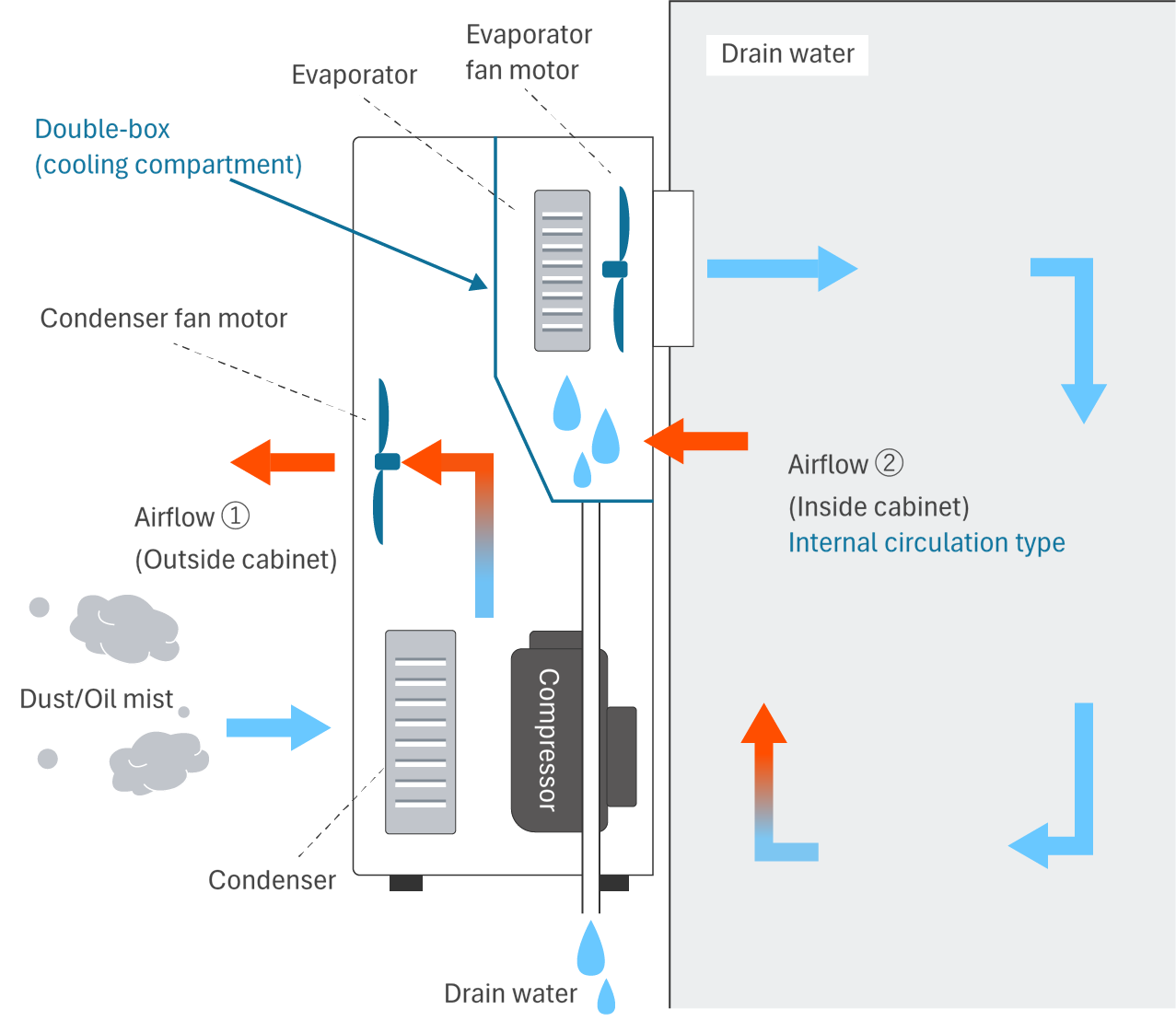
The structure of our Enclosure Cooling Unit is, Internal circulatory structure Also, Double box structure The first two are the following.
Therefore, even environment with dust and oil mist, dirty air is not drawn into the board and the inside of the board can be kept clean.
Point 1: There are two systems of wind flow on Enclosure Cooling Unit: "inside the board" and "outside the board".
Point 2: There is a sealed double box (cooling room) inside Enclosure Cooling Unit that is independent of the outside of the board.
Point 3: Dirty air on the outside heat dissipation side of the board is, No intrusion into the board. The following is a list of the most common problems with the
Point 4: For this reason, Circulation path in the board is equivalent to IP54 It is. * Excluding the drain pipe section
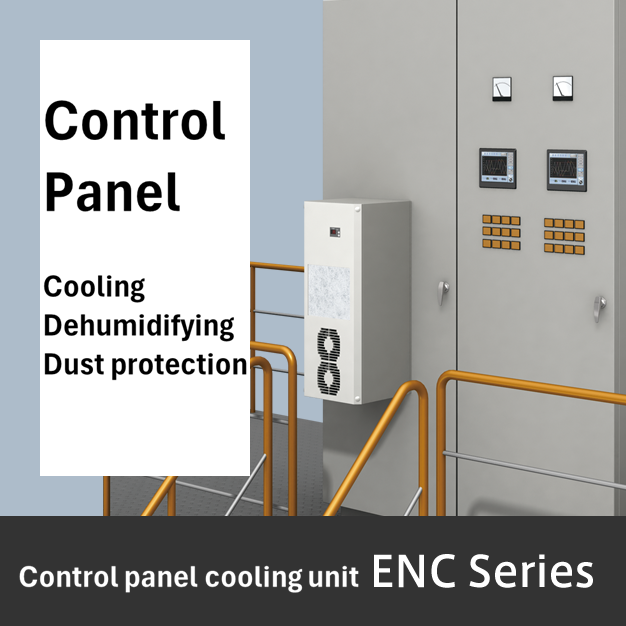
Side mounting type

Use a Enclosure cooling unit to make the internal board environment the best condition it can be!
Enclosure Cooling Unit protect electronic equipment inside panel from heat, dust, and moisture, contributing to the stable operation of the production line.
Please check the catalog for the latest lineup, features, and characteristics.
Equipped with freezing cycle for cooling and dehumidification
Enclosure Cooling Unit is a structure in which the indoor and outdoor units of a room air conditioner are compactly combined into a single unit.
The "condenser" corresponds to the outdoor unit and the "evaporator" corresponds to the indoor unit.
condenser is the heat absorbed outside the board. Release heat because of ... "Heat sink." It is also referred to as
It is the side of the outdoor unit where the warm air comes from.
evaporator in the board. Absorb heat The temperature is lowered and cooled down by the Cooler." It is also called "air conditioner unit. This refers to the main unit of the air conditioner, the indoor unit side that emits cold air.
Condensers and evaporators are, heat exchanger This is called "heat transfer" and takes advantage of the property of heat transfer from high altitude to low altitude.
freezing cycle The most important role in the refrigerant is refrigerant Ha, Heat carrier The company has been working on a new project.
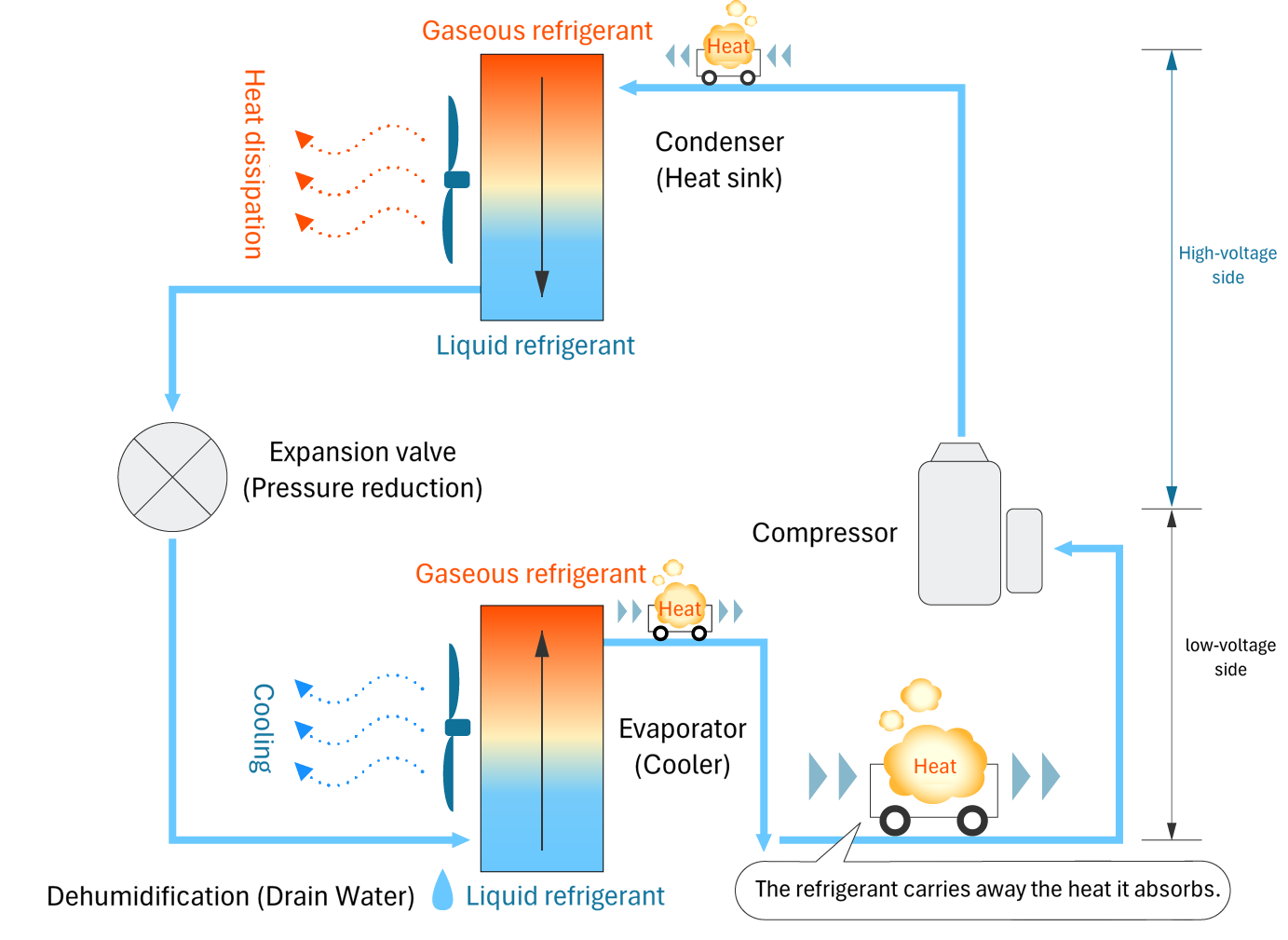
freezing cycle is illustrated below:
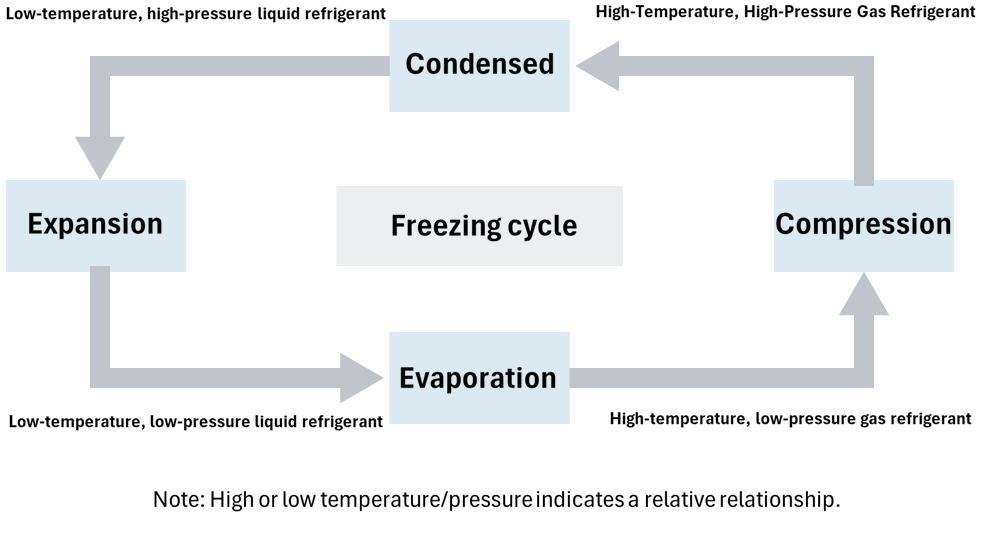
- Compression
- In order to condense and liquefy gas refrigerant using room temperature air or water, the temperature of refrigerant must be raised further, so the gas refrigerant is continuously compressed in the compressor, raising its temperature before being discharged.
- Condensation
- When high-temperature, high-pressure gas refrigerant is cooled by the surrounding air or water, it condenses and becomes a liquid, releasing the heat that was exchanged in the condenser.
- Expansion
- The high-pressure liquid refrigerant expands immediately after its flow is restricted by the expansion valve, and as some of the liquid refrigerant evaporates, it absorbs heat, lowering refrigerant 's temperature.
- Evaporation
- The low-temperature, low-pressure liquid refrigerant absorbs heat from the air it comes into contact with and evaporates. The air that absorbs the heat is cooled and sent out as cool air.
A quick explanationHeat Exchanger Efficiency and Causes of Insufficient Cooling
The cooling capacity of cooler varies depending on its heat exchange capacity.
The efficiency of a heat exchanger depends on the following factors:
①The temperature difference between the object being heat exchanged is large
②Good heat transfer (thermal conduction)
3) Large contact area for heat exchange
④Air volume for heat exchange
From the above, the reasons why cooler does not cool are
・Ambient temperature is high ⇒ The temperature difference in heat exchange decreases (①)
・ clogging filter ⇒ Heat dissipation decreases, reducing the temperature difference (①④)
・Fin contamination ⇒Thermal conduction on the fin surface deteriorates and the contact area also decreases (②③)
・Fan airflow rate decreases ⇒ heat dissipation rate decreases (④)
This means that...
To ensure efficient cooling, it is important to use the unit in a good environment and perform regular maintenance.
Apiste 's unique "mild cooling" for safe and comfortable cooling and dehumidification
Enclosure Cooling Unit can be broadly categorized into two types.
• cooler that cools quickly: "Rapid Cooling Type"
For those who believe that it's better to cool the inside of panel quickly, a rapid cooling type Enclosure Cooling Unit.
• cooler that cools slowly: "Mild Cooling Type"
Enclosure Cooling Unit situations where internal equipment generates heat and the internal temperature rises, and it's best to cool it down slowly and gradually. Apiste 's Enclosure Cooling Unit have been based on a unique mild cooling concept since their initial development.
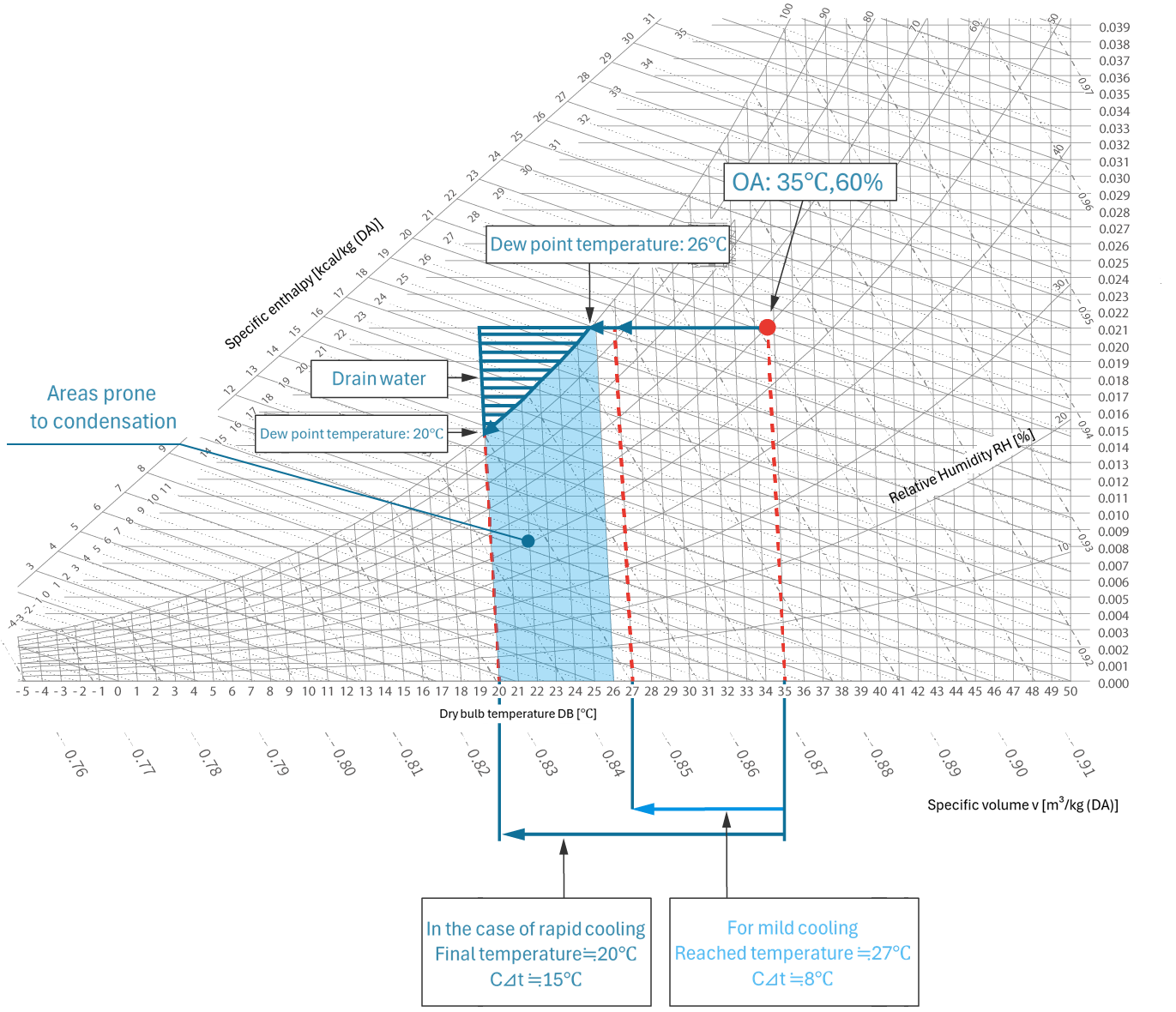
The psychrometric chart below compares the results when the temperature inside panel is 35°C/60% and cooled using ① rapid cooling (discharge temperature difference = 15°C) and ② mild cooling (discharge temperature difference = 8°C).
35°C/60% dew point temperature ≒ 26°C (there is a risk of condensation if the temperature drops below the dew point)
・Temperature reached in case of rapid cooling: ≒ 20℃
・Temperature reached in case of mild cooling: ≒ 27℃
-What are the problems with rapid cooling?
① Due to supercooling, the temperature drops below the dew point, making condensation more likely to occur.
② There is a possibility that drain water will suddenly come out.
-What are the benefits of mild cooling?
1. The dew point temperature is unlikely to be exceeded, so the risk of condensation is extremely low.
② There is a low risk of drain water suddenly coming out.
The difference between rapid cooling and mild cooling is shown in the psychrometric chart below.
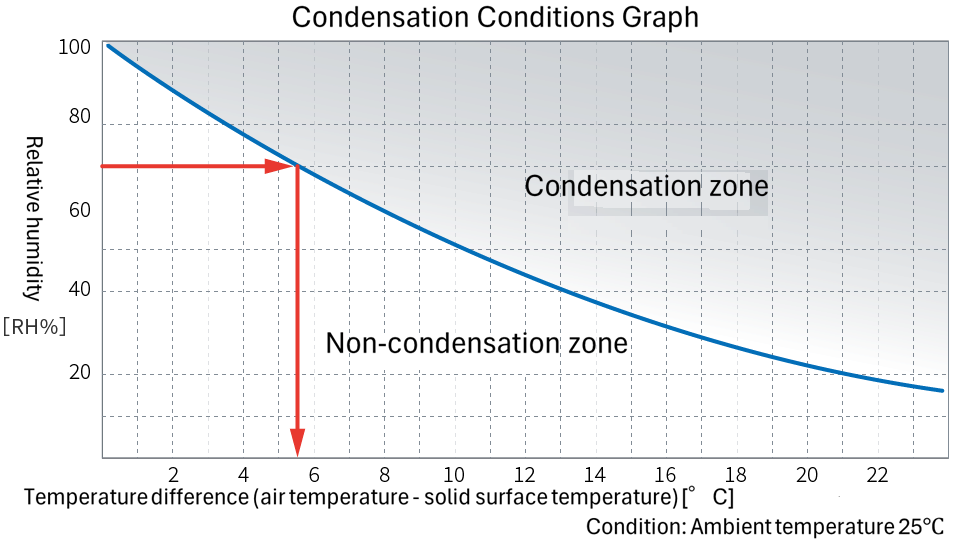
Condensation occurrence conditions characteristics
Use a Enclosure cooling unit to make the internal board environment the best condition it can be!
Enclosure Cooling Unit protect electronic equipment inside panel from heat, dust, and moisture, contributing to the stable operation of the production line.
Please check the catalog for the latest lineup, features, and characteristics.