

Technical Information
Freezing cycle
This explains the mechanism of freezing cycle used in air conditioners and cooling devices.
(1) What is freezing cycle?
「冷却の原理」でものを冷やす原理を学んできました。物質は蒸発するとき大量の熱を周囲から奪い、凝縮するときは大量の熱を周囲に放出します。
この原理を踏まえると、空間を冷却し続けるためには、蒸発潜熱の大きい物質を冷たい液体の状態で冷却する空間に連続して供給し、蒸発させ続ける必要があります。そのためには、熱をもらって蒸発した物質から熱を奪い、元の冷たい液体の状態に戻す必要があります。
この時に、熱を媒介する物質を冷媒といいます。冷媒の状態変化や温度変化をコントロールして持続的に冷却を行う仕組みのことを冷凍サイクルといいます。
(2) freezing cycle mechanism
The vapor compression freezing cycle is most commonly used in room air conditioners and industrial cooling systems. It consists of four elements: a compressor, a condenser, an expansion valve (capillary), and an evaporator. The inside of the system is sealed, and refrigerant circulates in a certain direction while changing state to provide cooling.
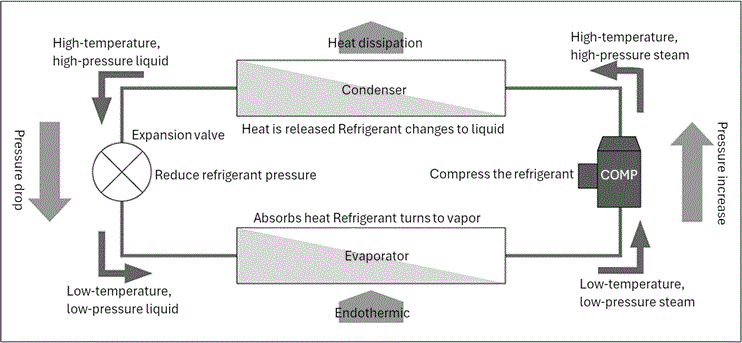
① Compression
The gas refrigerant that has absorbed the heat must be fed back into the low-temperature liquid. In order for cooling to occur using ambient air or room temperature water, which are easily accessible, the temperature at which the refrigerant condenses must be higher than those temperatures.
Stewed food in a pressure cooker will rise in temperature without boiling to about 120°C when pressure is applied. This makes it possible to cook at higher temperatures.
refrigerant Similarly, in the case of the "2." process, the condensation temperature can be raised by increasing the pressure. In the process of compression, low pressure and low temperature refrigerant are compressed in a compressor to increase pressure. At this time, heat of compression is also generated, so the temperature also rises, resulting in a high-temperature, high-pressure gas.
②Condensation
In the case of a room air conditioner, this corresponds to the outdoor unit. The high-temperature, high-pressure refrigerant in step ① is cooled and condensed using the surrounding air or water in the condenser. The temperature of the air or water used for cooling rises as the heat of condensation is released. In this way, the heat of evaporation absorbed when cooling the space and the heat of compression received from the compressor are released outside the cycle.
At this time, refrigerant changes from gas to liquid, but because it is changing state, its temperature does not change and it becomes a high-temperature, high-pressure liquid.
③ Expansion
The flow of high-temperature, high-pressure liquid is restricted by the expansion valve and then released, causing a sudden drop in pressure. At this time, some of refrigerant evaporates, and the heat of vaporization lowers the temperature of most of the remaining liquid. In this way, the liquid changes to a low-temperature, low-pressure liquid, which can then be easily evaporated in the evaporator.
④Evaporation
In the case of a room air conditioner, this corresponds to the indoor unit, and is the process that actually performs the cooling.
The low-temperature, low-pressure refrigerant evaporates in the evaporator by taking heat of evaporation from the surrounding air, which lowers the temperature of the surrounding air.
At this time, refrigerant changes state from liquid to gas, so there is no change in temperature and it becomes a low-temperature, low-pressure gas.
Table. Summary of refrigerant state during freezing cycle
| Four element parts | refrigerant condition | Temperature | Heat transfer | |
|---|---|---|---|---|
| ① Compression | Compressor | Low temperature/low pressure gas → high temperature/high pressure gas | Low temperature → High temperature | + Compression heat |
| ② Condensation | condenser | High-temperature, high-pressure gas → high-temperature, high-pressure liquid | High temperature (constant) | -Condensation heat (= -heat of evaporation - heat of compression) |
| ③ Expansion | Expansion valve | High temperature and high pressure liquid → Low temperature and low pressure liquid | High temperature → Low temperature | No heat balance |
| ④ Evaporation | evaporator | Low temperature/low pressure liquid → low temperature/low pressure gas | Low temperature (constant) | + Heat of evaporation |
People who viewed this page also checked out these documents:
Inquiry
For product inquiries, quote requests, etc.
Please feel free to contact us.