

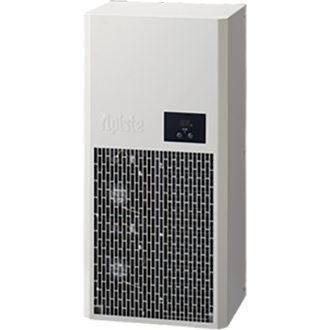
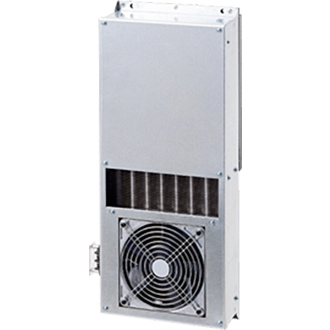
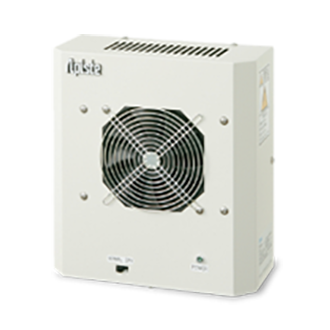
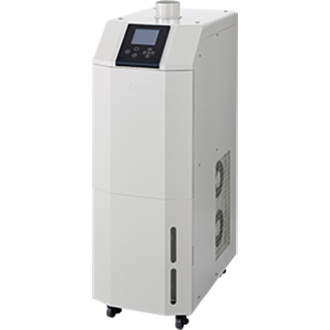
chillers (cooling water circulation device/unit cooler)


HFC alternative, energy-saving, wide range Apiste Chiller
- Does more than just cooling
Chiller PCU series


Select chillers (cooling water circulation device/unit cooler) from the product categories.

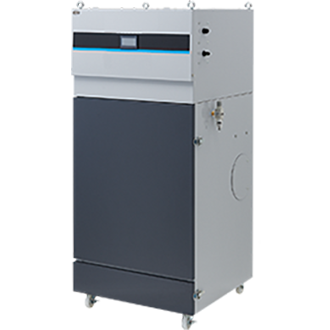
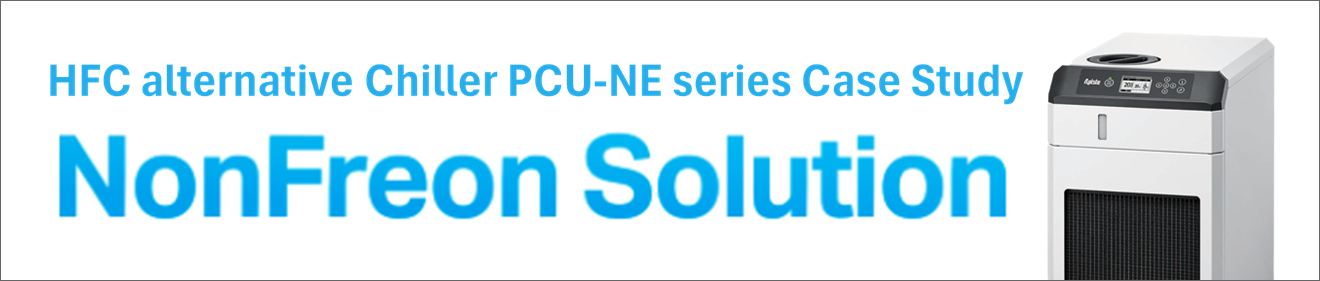
HFC alternative chiller
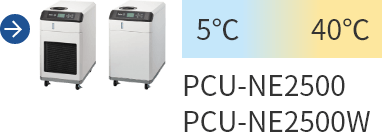
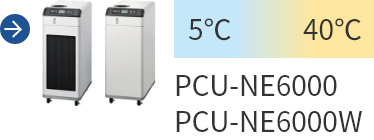
The PCU-NE series is a new chiller that is the first in the industry to use HFC-alternative refrigerants and also comes equipped with two industry-first features: a drive recorder and a time calendar.

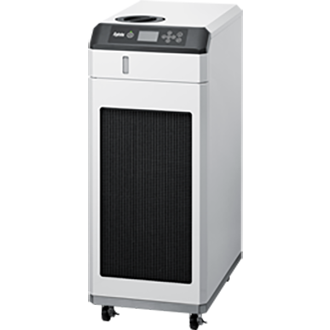
Highly durable, energy-saving chiller
This chiller combines high energy-saving performance of up to 50% with durability that can withstand harsh field environment and outdoor use. It also has high-temperature precision and is suitable for a variety of applications.

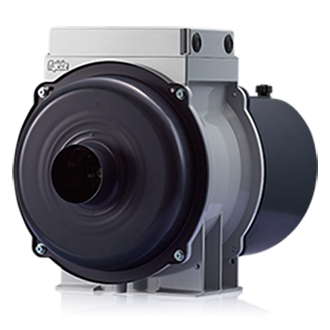
Wide range High stability Chiller
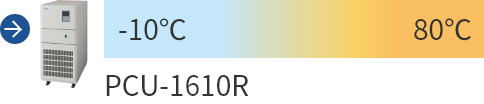
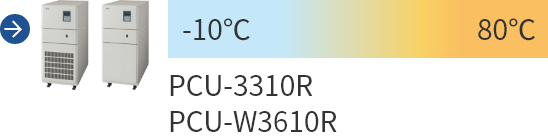
Controls circulating water over wide range of -10°C to 80°C and with a high precision of ±0.05°C. Widely used in manufacturing, development, and research fields.

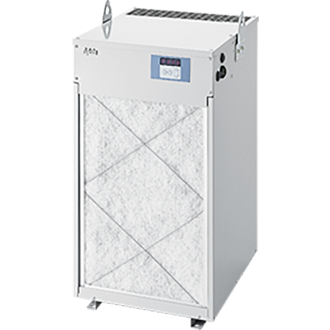
HFC alternative pumpless/tankless chiller
The PCU-F series has a structure that does not have a pump or tank inside the main body. This structure greatly improves design freedom and allows for flexible response to a variety of needs.
Choose from chiller cooling capacity
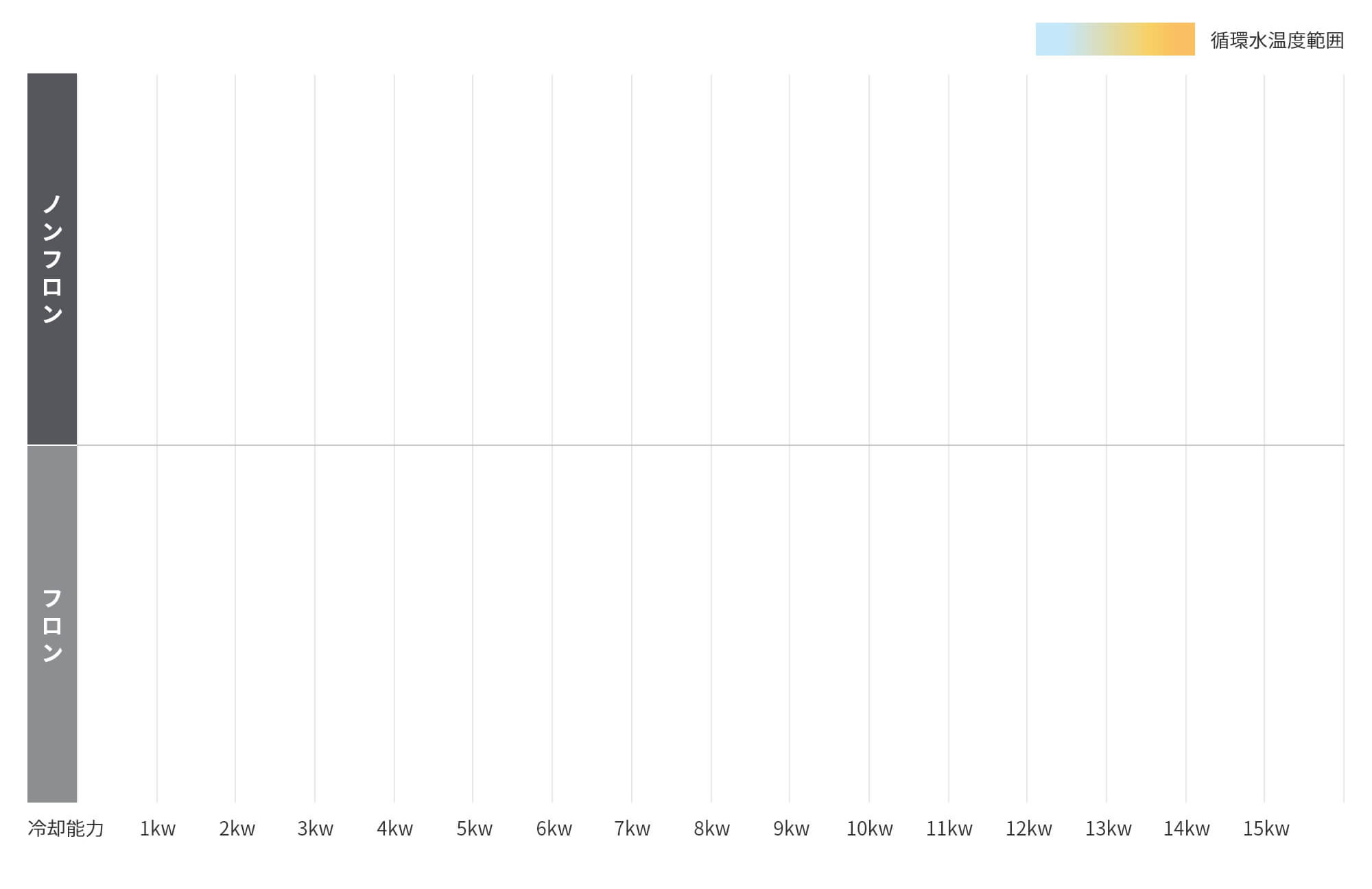
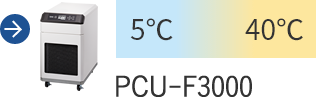
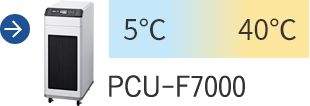
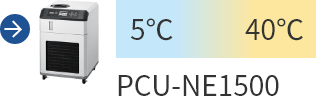
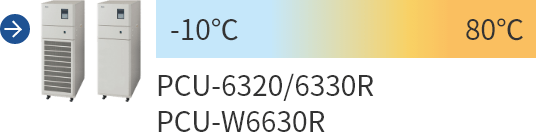
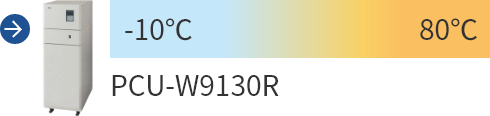
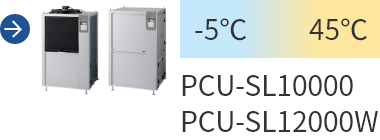
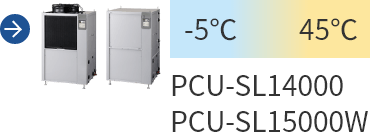
If you are having trouble selecting a product or would like to discuss implementation,
please feel free to contact us.
Select a chiller based on its features
Chillers (cooling water circulation system/unit cooler) option
What is a chiller (cooling water circulation device/unit cooler)?
A chiller is a device that cools or regulates the temperature of a heat source by circulating water or other fluids maintained at a constant temperature. It is also sometimes referred to as a “chiller,” “chiller unit,” “unit cooler,” or “cooling water circulation system,” all of which are synonymous terms. Chillers are used in a wide range of applications, including industrial machinery, medical equipment, scientific and laboratory instruments, and food processing machinery.
By efficiently removing heat generated by equipment and processes, we contribute to the stable operation of facilities, the maintenance of product quality, and improved production efficiency.
How a Chiller Works
A chiller cools by using a “water circuit” that absorbs heat from the object being cooled and a “refrigeration cycle” that releases that heat to the outside. The circulating fluid absorbs heat from the equipment or workpiece, exchanges heat with the refrigerant in the chiller’s evaporator, and then returns the cooled fluid to the object being cooled.
The refrigerant circulates through the compressor, condenser, expansion valve, and evaporator, absorbing heat and releasing it to the outside. This mechanism allows the temperature of the object being cooled to be maintained at a constant level.
Types of Chillers
Chillers can be classified based on several factors, such as their cooling method and whether they include a water tank. Here, we’ll introduce some common classification methods.
Classification by Cooling Method
Chillers are primarily classified into “air-cooled” and “water-cooled” types based on the method used to discharge heat from the refrigerant to the outside.
Air-cooled chillers use air drawn in by a fan to dissipate heat from the refrigerant. They are easy to install because they do not require a cooling water system, and they offer great flexibility in terms of installation location.
Water-cooled chillers use cooling water to dissipate heat from the refrigerant. They are less susceptible to ambient temperature fluctuations and are well-suited for applications that require stable cooling.
Classification Based on the Presence or Absence of an Aquarium
There are two types of chillers: “chillers with built-in water tanks,” which have a tank for storing cooling water built into the main unit, and “chillers without water tanks,” which do not have an internal tank.
Tank-integrated chillers can be connected directly to the equipment to provide cooling. On the other hand, tankless chillers can be connected directly to open tanks or existing cooling circuits.
Since each has different connection methods and uses, it is important to select the appropriate one based on the system configuration and operational methods.
How to select a chiller
Four steps to confirm and decide on a chiller
It is important to select a chiller that is suited to the equipment and work being cooled, and it is also important to match the conditions and circumstances of use with the chiller’s functions, performance, and specification.
-
STEP1
Determination of circulating water temperature
The circulating water temperature is determined based on the optimum temperature of the workpiece and equipment. Learn more -
STEP2
Determining the cooling method and location
Decide on the cooling method and installation location, such as air-cooling type or water-cooling type, indoors or outdoors. Learn more -
STEP3
Calculation of required cooling capacity
Calculate the required cooling capacity. Learn more -
STEP4
Determining Pump Capacity
Determine the pump capacity (head) required to circulate the cooling water. Learn more
Easy Chiller Selection Tool
If you have already decided on the conditions for the chiller you want to select, you can easily select the chiller that suits your purpose from this page.

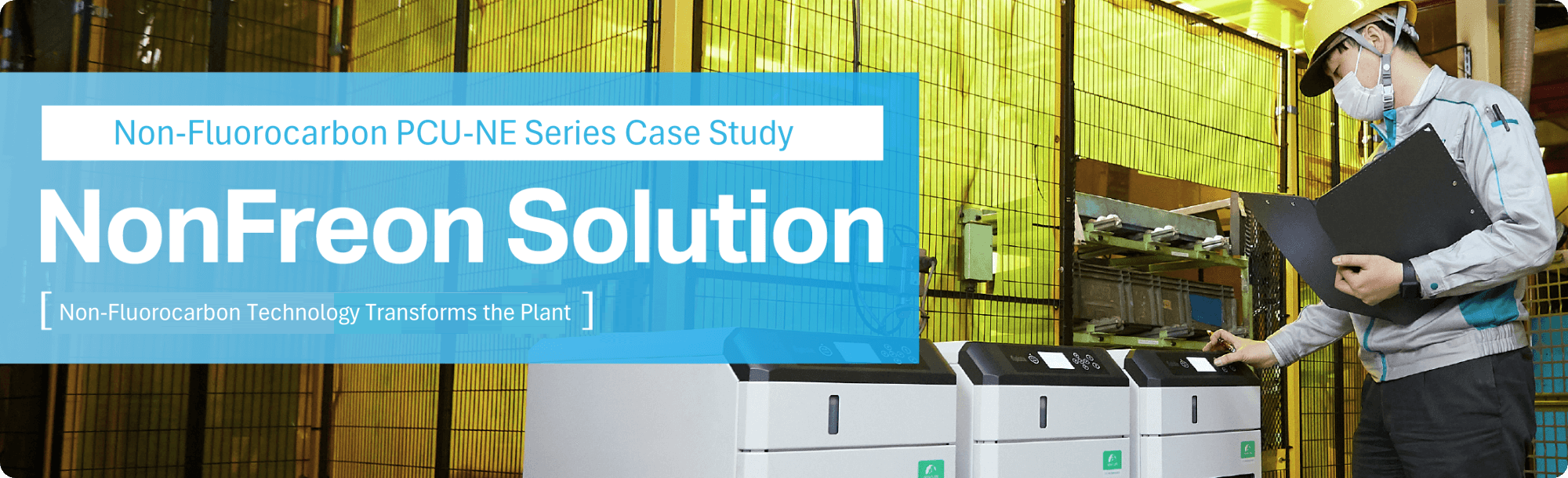
Chiller installation examples
Chiller FAQs
What is the service life of the chiller?
The service life (lifespan) of a chiller varies depending on the equipment’s usage and installation environment.
To maintain the cooling performance of the chiller and ensure stable use,
please carry out daily inspections in addition to other regular inspections and maintenance.
Please check the following items as part of your daily inspections.
- Installation method: Do not place heavy objects on the device or apply excessive force to piping, etc.
- Installation environment: Ambient temperature and humidity must be within specification range.
- Leakage: There should be no cooling water or circulating water leaks from the piping connections.
- Circulating water: The amount of circulating water should not be too small.
- Operating condition: No abnormal noise, vibration, strange odor, or smoke.
- Cooling water: Temperature, flow rate, and pressure must be within specification range. There must be no dirt or foreign matter mixed in.
- Filter: Not clogged.
Additionally, the following may indicate risk of failure or impaired performance due to degradation over time.
- The water temperature does not reach the set temperature (does not cool)
- Compressor stops or won’t start
- Lots of vibration and noise
- No power supply
In the above cases, symptoms may improve with appropriate treatment.
If the symptoms do not improve, please contact our sales department or visit our website.
Please refer to the instruction manual for details on daily inspections and how to deal with equipment problems.
Please contact us here for inquiries regarding repairs, inspections, etc.
Please let me know the price and delivery date of the chiller.
We carry out strict inventory management for each product every day so that we can deliver the products you need to our customers without making them wait.
In the unlikely event that a problem occurs and you need a product immediately, we can respond with a short delivery time.
For prices and delivery times, please contact us here.
How do I select a chiller?
To select a chiller, it is necessary to understand the heat output of the equipment. There are several ways to calculate this, including calculating it from the equipment specification, calculating it from the flow rate and temperature difference of circulating water, or estimating it from the existing cooling equipment.
For details, please refer to “How to Select a Chiller (PCU Series).”
What is the temperature adjustment range of Apiste 's chiller (cooling water circulation device)?
The temperature adjustment range varies depending on the product series as shown below. Please refer to the instruction manual for details.
| Product series | Temperature Adjustment Range |
|---|---|
| HFC alternative chiller (PCU-NE series) | 5~40℃ |
| Highly durable and energy-saving chiller (PCU-SL series) | -5~45℃ |
| wide range, high-stability chiller (PCU-R series) | -10~80℃ |
| HFC alternative pump/tankless chiller (PCU-F series) | 5~40℃ |
Is it possible to rent a chiller (cooling water circulation device) test machine?
Yes, you can use the test machine for free. If you would like to rent one, please apply here.
I would like to request a quote for a factory chiller (unit cooler).
If you would like a quote, please contact us here.
Purchase Support
Related information





Related Products
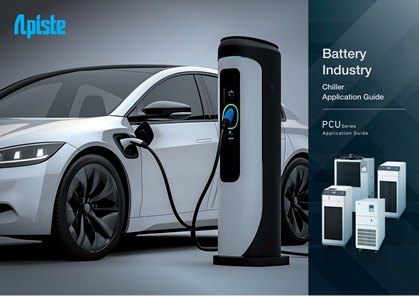
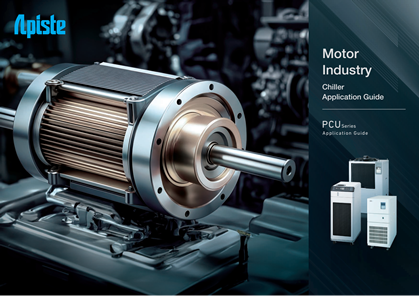
People who viewed this page also checked out these documents:
Inquiry
Please feel free to contact us with any questions about our products or to request a quotation.