 最近チェックした商品

Thermal expansion coefficient
This section explains the expansion and contraction of materials due to temperature changes. In addition to explaining the thermal expansion coefficient, we also introduce the thermal expansion coefficients of representative materials.
Table of Contents [display]
This article explains how materials expand and contract due to temperature changes.
Thermal expansion
Thermal expansion is the phenomenon in which the volume of an object increases as its temperature rises.
For example, in the case of 1m of iron, a temperature change of 10°C will cause an error of more than 100μm.
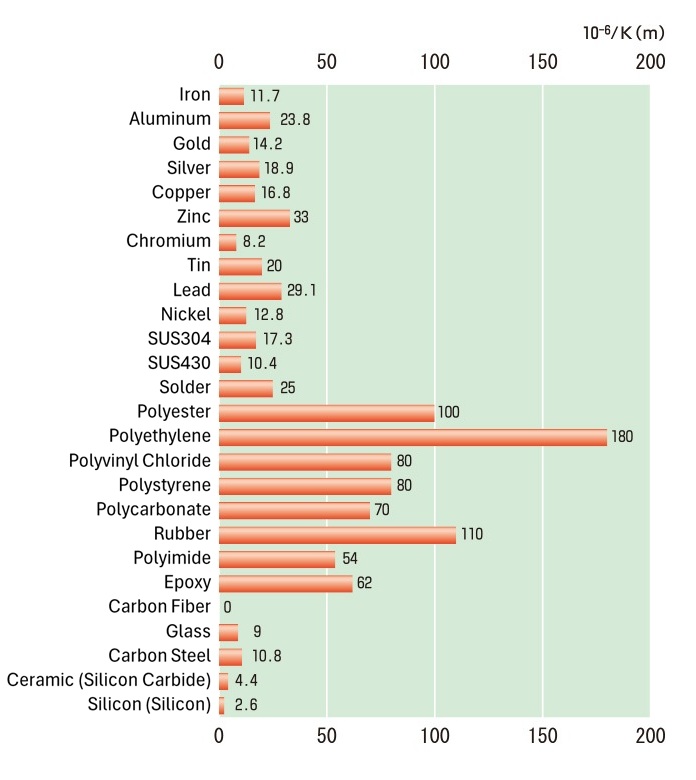
The rate of expansion of an object per degree Celsius is called the thermal expansion rate.
List of thermal expansion coefficients of representative materials
The relationship between air conditioning and thermal expansion
There is a significant difference in the size of substances under general air conditioning and precision air conditioning.
For general air conditioning
With general air conditioning, the temperature environment in which products, testing and research materials, and manufacturing and testing equipment are placed fluctuates greatly due to factors such as changes in outside temperature.
This temperature change causes the size of the material and the equipment itself to change due to thermal expansion.
Precision air conditioning
With general air conditioning, fluctuations of about ±5°C from the set temperature are expected, whereas precision air conditioning allows for a temperature environment of ±0.1°C.
Precise temperature control is essential for improving quality at manufacturing sites.
Comparison of thermal expansion under general air conditioning and precision air conditioning
Here, we compare the displacements assuming that environment temperature changes throughout the year by 10°C under general air conditioning and 0.2°C under precision air conditioning, and that the material also has the same temperature as environment temperature.
Temperature changes throughout the year
General air conditioning = ±5℃:
Precision air conditioning = ±0.1℃
The change per 1m of material is as shown in the table below.
By suppressing temperature changes, the change in size of a substance can be reduced to this extent.
| Material | General air conditioning | Precision air conditioning | Material | General air conditioning | Precision air conditioning |
|---|---|---|---|---|---|
| Iron | 0.117 | 0.00234 | Polyester | 1 | 0.02 |
| Aluminum | 0.238 | 0.00476 | Polyethylene | 1.8 | 0.036 |
| Gold | 0.142 | 0.00284 | Polyvinyl chloride | 0.8 | 0.016 |
| Silver | 0.189 | 0.00378 | Polycarbonate | 0.7 | 0.014 |
| Copper | 0.168 | 0.00336 | Rubber | 1.1 | 0.022 |
| Zinc | 0.33 | 0.0066 | Polyimide | 0.54 | 0.0108 |
| Lead | 0.291 | 0.00582 | Epoxy | 0.62 | 0.0124 |
| Nickel | 0.128 | 0.00256 | Glass | 0.09 | 0.0018 |
| SUS304 | 0.173 | 0.00346 | Ceramic (silicon carbide) | 0.044 | 0.00088 |
| Solder | 0.25 | 0.005 | Silicon | 0.026 | 0.00052 |
The storage conditions of raw materials improve manufacturing quality and yield.
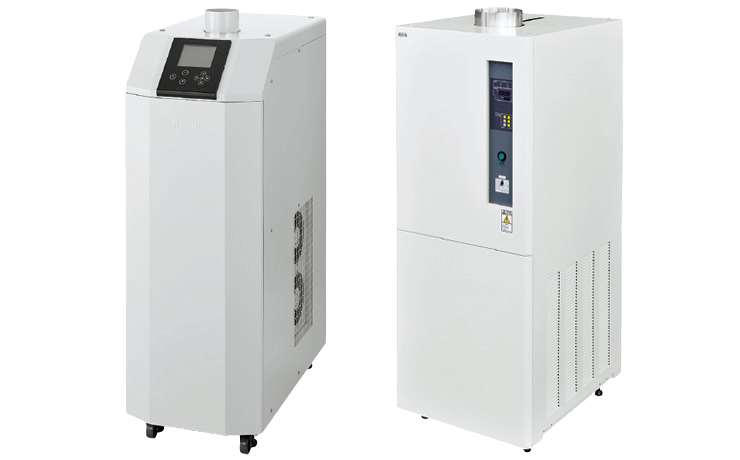
Apiste 's PAU series precision air conditioner (TCU/ECU)
Maintaining consistent quality of parts and raw materials in storage improves yield.
- Production quality and yield are unstable depending on the season and time
- I want to eliminate temperature control that relies on experience and intuition
- We want to prepare manufacturing conditions for the automation of the manufacturing process.