 最近チェックした商品

Air conditioning process and psychrometric chart
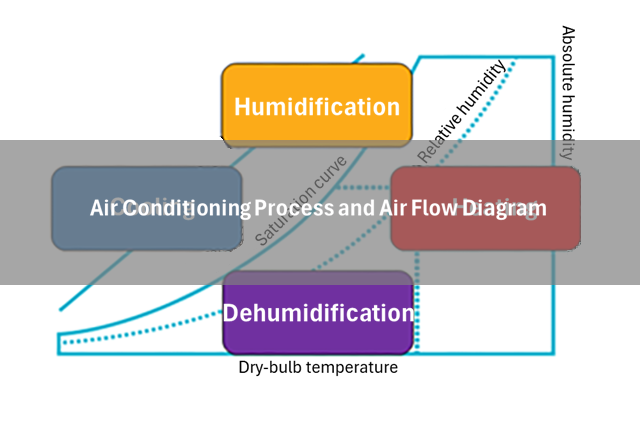
We will use diagrams to clearly explain how each air conditioning process, such as heating, cooling, humidification, and dehumidification, is represented on a psychrometric chart.
Table of Contents [display]
This article explains each air conditioning process, such as heating, cooling, humidification, and dehumidification, and how air moves along the air line.
Heating
There are various types of heating, such as "resistance heating," "far-infrared heating," and "induction heating," but the behavior on the psychrometric chart is basically the same for all of them.
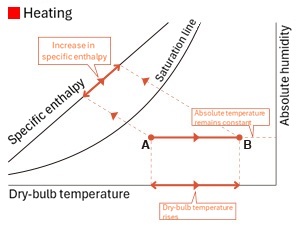
When air is heated using an electric heater, the dry-bulb temperature rises, but the amount of water vapor contained in the air does not change.
In other words, the absolute humidity remains constant and only the temperature increases, so the state line representing this process becomes horizontal as shown in the figure on the right.
This type of change is called "sensible heat change." At this time, the heat content of the air also increases from A to B, and the specific enthalpy, which is the difference in heat content, also increases.
Cooling
Cooling does not simply lower the temperature, but also removes humidity during the cooling process, resulting in "cooling dehumidification."
When temperature changes with such a change in absolute humidity, the amount of change in enthalpy is large.
Let's compare the enthalpy when humid air A (high absolute humidity) and A' (low absolute humidity) reach the same temperature and humidity state B using the diagram on the right.
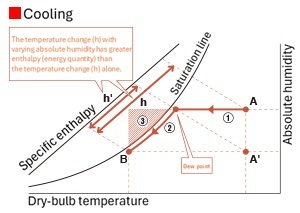
It is clear that cooling while dehumidifying requires more energy. In other words, temperature control that involves changes in absolute humidity requires a very large amount of energy.
Humidification
Humidification methods are broadly divided into "steam humidification" and "water humidification."
A thorough understanding of humidification requires a fairly specialized explanation, so here we will use a psychrometric chart to explain the air conditioning process when using actual humidifier equipment.
Steam humidification
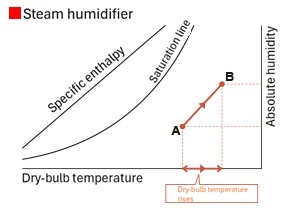
Steam humidification methods involve heating the water in a container using an electric heater or other device, causing it to evaporate, and then humidifying the air with the resulting steam. Pan-type humidifiers are the most common.
Steam humidification releases water vapor at nearly 100°C into the air, causing the ambient temperature to rise.
Water type humidification
Dehumidification can be broadly divided into two methods. One is "cooling dehumidification," which was mentioned in the "cooling" section, and the other is "adsorption dehumidification."
Here we will explain the adsorption type dehumidification method.
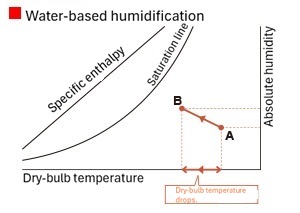
Dehumidification
For example, when the dry bulb temperature is 25°C and the relative humidity is 60%, the specific enthalpy is 55.42 KJ/Kg(DA).
Please use the simple glossary below to help you understand psychrometric charts.
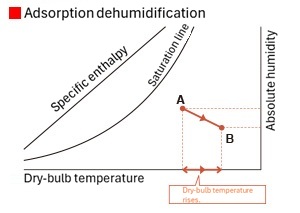
Adsorbent dehumidification
Unlike cooling dehumidification, adsorption dehumidification has a much higher dehumidification capacity, theoretically reaching 0%.
However, with "chemical adsorption" types such as silica gel, moisture must be removed to restore moisture absorption, which generates heat.
In addition, running costs such as electricity bills will also increase.
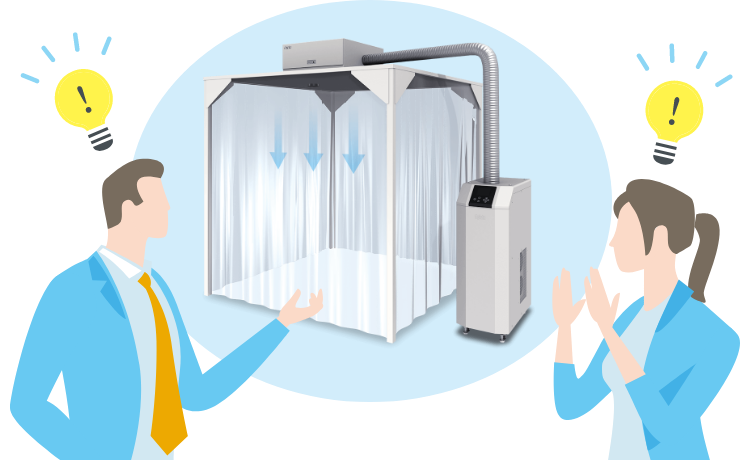
We make it easy to achieve a high-stability environment that may seem difficult.
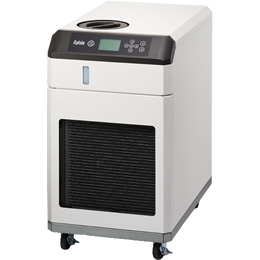
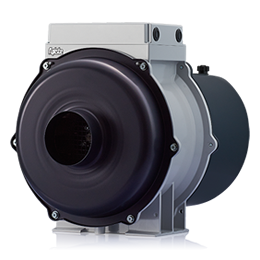
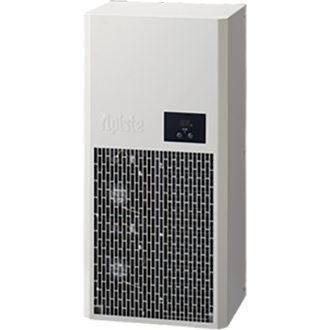
Apiste 's many years of know-how and precision air conditioner (TCU/ECU) PAU series will create a constant temperature and humidity environment.
- Temperature stability ±0.1℃
- Humidity stability ±0.5%RH
- Simply surround the target space and connect it with a duct