Clean room
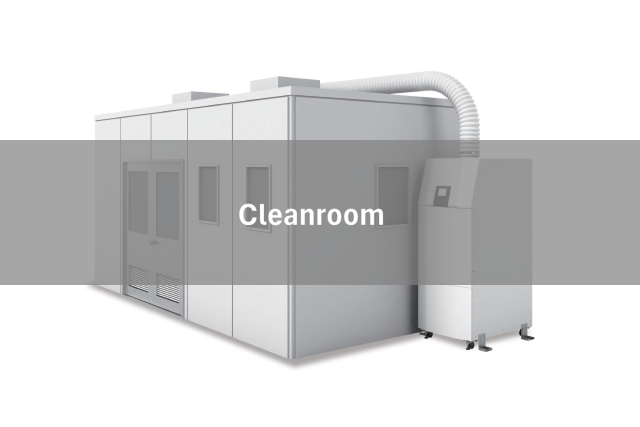
Clean environment is required in various fields such as precision equipment and parts processing and pharmaceuticals. Methods to create cleanliness, conditions to maintain it, etc. This lecture will explain the basics in an easy-to-understand manner.
Table of Contents [display]
- The four elements of air conditioning
- environment standards for general air-conditioning environment
- Cleanliness of general air-conditioning environment
- Cleanliness in the manufacturing process
- Clean room
- Contamination
- Clean standards and cleanliness levels (classes and cleanliness levels)
- Cleanliness measurement
- Cleanliness and air filter
- Four cleanroom principles for maintaining cleanliness
The four elements of air conditioning
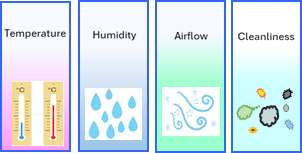
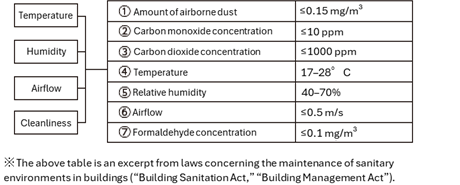
Air conditioning involves adjusting the air conditions to suit the use and purpose of a space. To do this, four elements - temperature, humidity, cleanliness, and airflow - must be adjusted to create a uniform and appropriate indoor environment.
environment standards for general air-conditioning environment
In Japan, various laws stipulate a comfortable air environment to protect the health of the people. Even under general air conditioning, the management targets for temperature, humidity, cleanliness, and airflow are quantified as shown below.
Examples: Building Sanitation Act, Building Standards Act, Building Management Act, Occupational safety and Health Act, etc.
Cleanliness of general air-conditioning environment
In addition, the cleanliness of a general air-conditioned environment requires the removal of airborne particles such as dust, house dust, and pollen from the target space, such as indoors, as well as allergy-causing chemicals such as formaldehyde, and unpleasant odors.
Cleanliness in the manufacturing process
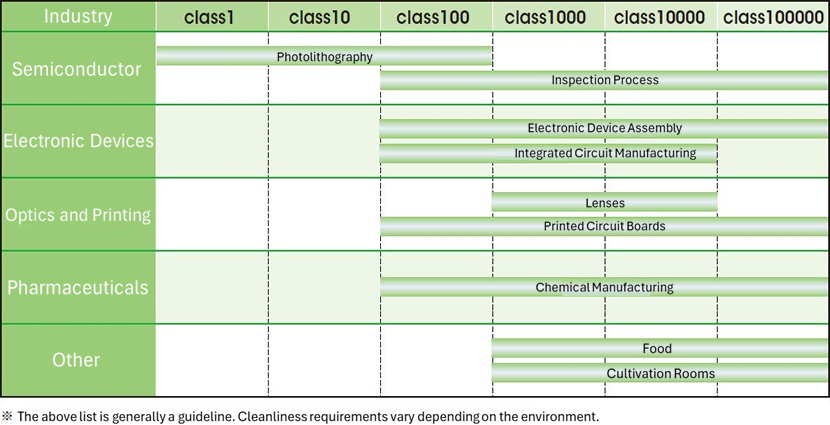
The level of cleanliness in manufacturing processes is generally referred to as cleanliness class, which indicates the degree of air pollution in the target space based on certain standards. A room that achieves and manages a certain level of cleanliness is called a clean room.
Clean room
A clean room is defined as:
Clean rooms are broadly classified into two types depending on their purpose of use.This is a room where airborne particles and microorganisms are kept below a certain level of cleanliness, and contamination control is carried out to prevent the introduction of impurities and foreign substances.The cleanliness of products, chemicals, and water brought into the room is also maintained, and environment conditions such as temperature, humidity, pressure, and airflow are controlled as necessary to create a comfortable working environment.
(Reference: JIS Z 8122)
Industrial Clean Room
It is primarily intended for industrial fields such as semiconductors, liquid crystal displays, electronic components, and precision instruments, and targets particles suspended in the air.
Biological Clean Room
It is primarily intended for use in the medical food industry, including pharmaceuticals, genetic engineering, biotechnology, and operating rooms, and targets airborne microorganisms.
Contamination
Contamination is the contamination of a product or food with foreign matter, impurities, or microorganisms. Contamination control is the process of preventing contamination from occurring.
In the manufacturing process, metal fragments, foreign matter, impurities, contaminants, etc. may be generated from environment the periphery of machinery, equipment, conveyors, etc., and may get mixed in or adhere to products. Especially in the semiconductor, electronics, precision parts, pharmaceutical, and food manufacturing fields, where clean environment management is strict, this can lead to major losses and loss of trust, such as lot-outs and recalls.
Countermeasures for this include the following.
- We will review the materials and change them to specification that are less susceptible to contamination.
- Clean thoroughly.
- Review the cleaning method.
- Use dedicated equipment.
- Conduct thorough inspections.
- Review the process to prevent specific substances from being mixed in.
- Provide thorough employee training.
Clean standards and cleanliness levels (classes and cleanliness levels)
Class (cleanliness) is a standard that defines the amount of particles in the air. Currently, it has been unified into the internationally unified ISO standard, but the previous US federal standard "FED-STD209D" is still widely used. The JIS standard is based on the basic ISO standard.
- ISO14644-1 (JIS B9920)
- It targets particles of 0.1 μm or larger per cubic meter of air, and is classified into classes 1 to 9. Like the ISO standard, the JIS standard also classifies particles of 0.1 μm or larger per cubic meter into classes 1 to 8.
- FED-STD-209D
- The classification is based on the number of 0.5 μm particles in the air per cubic foot (1 foot = approximately 30 cm).
■ Table 5. Measurable particle size and upper limit concentration by air cleanliness class
| Cleanliness Class | Upper limit concentration (pieces/m3 Upper limit concentration (pieces/m3)) | ||||||
|---|---|---|---|---|---|---|---|
| international unified standards ISO 14644-1 | Federal Standard FED-STD-209D | Measured particle size | |||||
| 0.1μm | 0.2μm | 0.3μm | 0.5μm | 1.0μm | 5.0μm | ||
| クラス1 | 10 | 2 | |||||
| クラス2 | 100 | 24 | 10 | 4 | |||
| クラス3 | 1 | 1,000 | 237 | 102 | 35 | 8 | |
| クラス4 | 10 | 10,000 | 2,370 | 1,020 | 352 | 83 | |
| クラス5 | 100 | 100,000 | 23,700 | 10,200 | 3,520 | 832 | 29 |
| クラス6 | 1,000 | 1,000,000 | 237,000 | 102,000 | 35,200 | 8,320 | 293 |
| クラス7 | 10,000 | 352,000 | 83,200 | 2,930 | |||
| クラス8 | 100,000 | 3,520,000 | 832,000 | 29,300 | |||
| クラス9 | 35,200,000 | 8,320,000 | 293,000 | ||||
Cleanliness measurement
The method for evaluating the air cleanliness of a clean room is specified in JIS B 9920. Generally, a particle counter is used to measure the number of particles by particle size.
<Notes>
When using particle counters, please be aware of the following points:
- The particle size, suction flow rate, and cleanliness of the object to be measured are suitable for the purpose.
- The more particles there are, the better stability.
- If the number of particles is too large, the error will be large.
- Counting particles smaller than specification will result in a large error.
Cleanliness and air filter
To satisfy the cleanliness (cleanliness) of a target space, there must be air filter that filters airborne particles. Air filter is broadly classified according to its collection efficiency as follows: HEPA is sometimes called quasi-HEPA filter while HEPA high-performance filter is close to HEPA filter.
| filter Types | Coarse dust filter | Medium-performance filter | HEPA filter | ULPA filter |
|---|---|---|---|---|
| Particle size guideline | Slightly coarse grain | Slightly fine particles | Very fine particles | |
| Particle size | 10~20μm or more | 1~2μm or more | 0.3 μm | 0.1 to 0.2 μm |
| Collection rate (approximate) | Approximately 50-90% | Approximately 50-95% | 99.97~99.99% | 99.999~99.99999% |
| Initial pressure loss (approximate) | Approximately 5-20Pa | Approximately 20-120Pa | Approximately 90-250Pa | Approximately 130-250Pa |
FFU (filter Fan Unit)
A clean air device that combines a HEPA filter and fan motor is called an FFU.

HEPA filter are an abbreviation for High Efficiency Particulate Air Filters, and are defined by the JIS standard as follows:
An air filter with a particle collection rate of 99.97% or more for particles with a particle size of 0.3 µm at rating air flow rate and performance initial pressure loss of 245 Pa or less.
(Reference: JIS Z 8122)
ULPA filter is an abbreviation for Ultra Low Penetration Air Filter, and is defined by the JIS standard as follows:
An air filter with a particle collection rate of 99.9995% or more for particles with a particle size of 0.15 μm at rating air flow rate and performance initial pressure loss of 245 Pa or less
(Reference: JIS Z 8122)
Collection efficiency
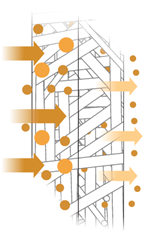
In order to remove suspended particles and pollutants from the air, filter must have a mesh size that is appropriate for the particle size of the particles to be captured. Collection efficiency is the percentage of incoming suspended particles that filter can capture, and the cleanliness level varies depending on the collection efficiency and height. However, since the method of measuring collection efficiency differs depending on filter 's performance classification, it is important to note that collection efficiencies with the same numerical value are not necessarily the same.
Weight method
weight captured by filter ÷ total weight flowing into filter
⇒The weight method may not be able to capture fine particles, but it will calculate a high collection efficiency if it captures large dust particles (coarse dust), so it is generally used to measure coarse dust filter.
Counting method
Number of particles of each size captured by filter ÷ Number of particles of each size flowing into filter
⇒The counting method is an evaluation method used for HEPA filter, etc., to count the number of particles and measure how much dust or airborne particles are captured by filter for each particle size.
For this reason, specification for HEPA filter state that they are "more than 99.97% effective against particles of 0.3 μm."
<Notes>
While HEPA and ULPA filter have high collection efficiency, if filter are used in places with a lot of suspended particles and dust, filter itself will become clogging quickly, causing a sudden drop in airflow and resulting in filter needing to be replaced more frequently. Therefore, it is necessary to consider the location of use and whether to use a pre-filter in combination.
Filter Pressure Drop
Filter have a fibrous mesh structure to capture suspended particles and dust. This creates resistance that hinders the flow of air through filter. The pressure difference is the pressure drop that occurs when the static pressure of a certain volume of air passes through filter. filter Pressure Loss It is called.
Static pressure of air before passing through filter- static pressure of air after passing through filter
⇒Pressure loss can be measured with a differential pressure gauge.
<Notes>
The pressure loss of filter when it is new is called the initial pressure loss, and as filter becomes clogging over time, the pressure loss of filter gradually increases, causing a decrease in collection efficiency and airflow. Also, in the case of fan motor with weak static pressure, using filter with a large pressure loss may cause the desired airflow to not be achieved, so care must be taken.
Four cleanroom principles for maintaining cleanliness
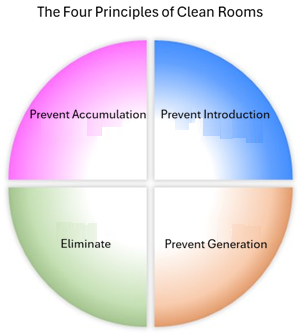
In order to maintain the cleanliness (purity) of a clean room at all times, it is essential to adhere to the "four principles of clean rooms."
- Do not bring
⇒Workers, fiber waste, hair, carts, equipment, metal pieces - Do not generate
⇒Workers, clothing, equipment, writing implements, sliding parts, transport, processing, painting - Do not deposit
⇒Cleaning method, angular areas, uneven areas - Eliminate
⇒Ventilation rate, ventilation method, dead zone, positive pressure
Airflow design guidelines for industrial clean rooms
The JIS standard recommends an airflow velocity of 0.2 m/s or more for clean rooms, but clean-related equipment manufacturers tend to select an airflow velocity of approximately 0.3 to 0.4 m/s. In the case of Apiste, it is set to 0.4 m/s.
| Cleanliness Class (JIS) | Cleanliness Class (FED) | Airflow type | Mean air velocity (m/s) | Ventilation frequency | |
|---|---|---|---|---|---|
| (Number of times/h) | (Number of times/h) | ||||
| 2 | - | Unidirectional flow | 0.3~0.5 | Not applicable | - |
| 3 | C1 | ↑ | ↑ | ↑ | - |
| 4 | C10 | ↑ | ↑ | ↑ | - |
| 5 | C100 | ↑ | 0.2~0.5 | ↑ | 200~400 |
| 6 | C1,000 | non-unidirectional flow or in combination | Not applicable | 30~90 | 100~150 |
| 7 | C10,000 | ↑ | ↑ | 20~40 | 30~75 |
| *JIS B 9919 | ← | ← | ※FED Hoka | ||
<Notes>
Even with low ventilation rates, using a HEPA filter can initially achieve a certain level of cleanliness. However, as the HEPA filter clogging deteriorates over time, there is an increased risk of increases in particle and contaminant concentrations and a decrease in capacity to restore cleanliness, and the cleanliness level may fall below the standard without you even realizing it.
Improve your factory's manufacturing quality through air conditioning!
Apiste 's precision air conditioner (TCU/ECU) PAU series improves yield and manufacturing quality cost-effectively.
- High-stability temperature control at low cost
- Want to control temperature and humidity for each process?
- Want to save more energy than with overall air conditioning or full-scale clean rooms?