Dehumidification
We will provide an easy-to-understand explanation of dehumidification, a topic that is often heard, starting with the basics of air, and explain the purpose and reasons for dehumidification, its uses in manufacturing processes, and typical dehumidification methods.
Table of Contents [display]
What is dehumidification?
Dehumidification generally refers to removing moisture from the air.
The relationship between air and humidity
First of all, the amount of water vapor that air (= humid air) can contain varies depending on the temperature. If we compare the air in a certain space to a balloon, when the temperature is cold the balloon shrinks and can hold less water. However, when the temperature is warm the balloon expands and can hold more water. This is because air itself expands and contracts with temperature.
Dehumidification, relative humidity, and absolute humidity
Dehumidification can be achieved by reducing absolute humidity and by reducing relative humidity.
Relative humidity
The ratio of the amount of water vapor that air at a certain temperature can contain to the maximum amount of water vapor that it can (= saturated water vapor amount) is called relative humidity (%RH).
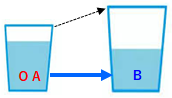
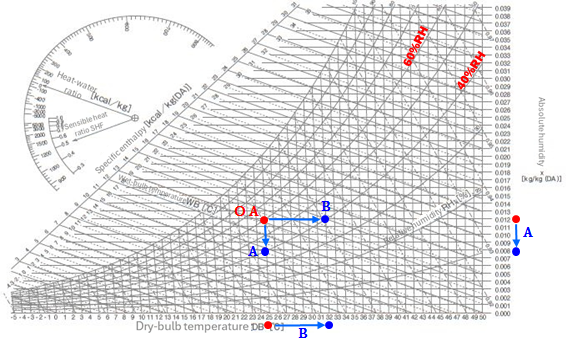
1. How to reduce weight of water vapor in the air and lower the absolute humidity (Figure below: OA⇒Point A)
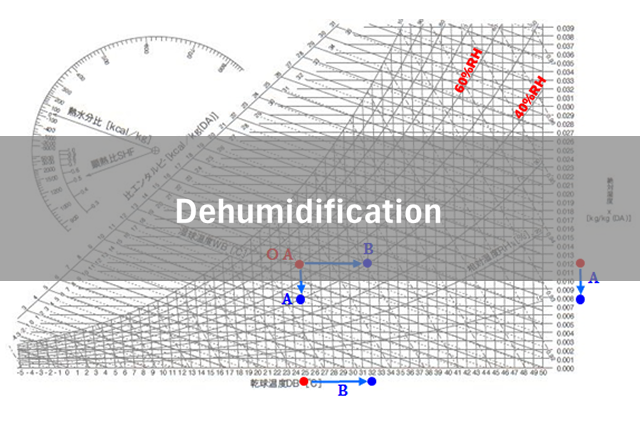
In the diagram below, when moving from point OA (25°C, 60% RH) to point A, the relative humidity drops from 60% RH to 40% RH.
We can see that the dry bulb temperature remains the same, but the absolute humidity has decreased.
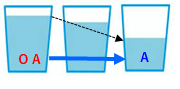
The size of the cup remains the same, but the amount of water in it has decreased.
Absolute humidity
The ratio of weight of water vapor to 1 kg of dry air is called absolute humidity (kg/kg (DA)). ... Weight
2. A method of lowering the relative humidity by heating the air even if weight of water vapor in the air remains the same (Figure below: OA⇒Point B)
In the diagram below, when moving from point OA (25°C, 60% RH) to point B, the relative humidity also drops from 60% RH to 40% RH.
The absolute humidity remains the same, but the dry bulb temperature has risen to 32°C.
The amount of water in the glass remains the same, but the glass has grown in size.
If you lower the absolute humidity while heating, the relative humidity will decrease even further.
Purpose and reason for dehumidification
The reasons for dehumidification in daily life are as follows:
- Reduces stuffiness and discomfort caused by high humidity
- Prevents condensation and mold caused by humidity
- Preventing odors and health problems caused by mold
Dehumidification requirements in manufacturing processes can be broadly categorized as follows:
- To keep the humidity below a certain level. Example: 40-50% RH, 60% RH or less
- To maintain low humidity. Example: 30% RH or less, dew point -40°C
Typical dehumidification applications
| Prevents metal corrosion and rust | Precision molds, printed circuit boards, lead frames, metal masks, ICs |
|---|---|
| Prevents short circuits caused by condensation | Printed circuit boards, microchips, electrical circuits, panel |
| Viscosity management | Resist liquid, cream solder, paste material, adhesive, hardener |
| Expansion and deterioration due to moisture absorption | Polymer compounds, high-performance films, molded packages, sealing materials |
| Weight change due to moisture absorption | Weighing, compounding, and storage of pharmaceuticals and chemicals |
| Deterioration due to moisture absorption | Storage facilities for powdered chemical raw materials, flour milling and confectionery, electrode materials, cultural assets and books |
| Poor molding | Tablets in a tablet press |
| powder | Chemicals, flour, cement |
| performance quality | Lithium-ion battery |
| Proliferation of viruses and bacteria | Food processing, cooking process, pharmaceutical and post-preparation storage |
Typical dehumidification methods
In the FA market for manufacturing processes, the following dehumidification methods are mainly used:
1. compressor type
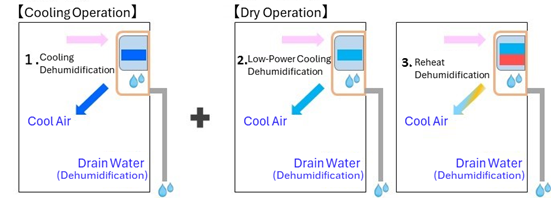
compressor type cooling device is an air conditioner or cooler that has freezing cycle. The dehumidification method using freezing cycle is called cooling dehumidification.
When cooler is turned on during the humid summer months, the cool air cools the room, and at the same time, the humidity inside the room is removed and discharged outside as drain water.General air conditioners have three dehumidification methods.
2. Peltier type
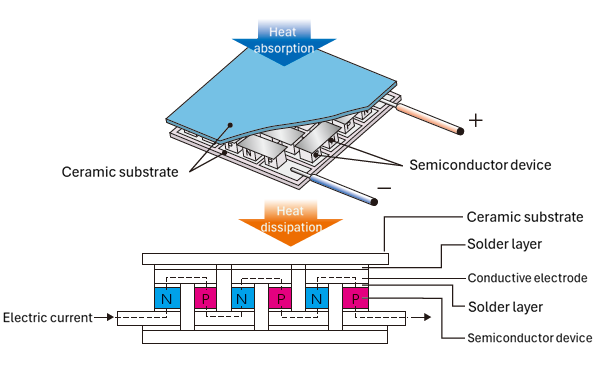
The structure uses a semiconductor Peltier element, and when moist air comes into contact with the cooling surface cooled by Peltier effect, the moisture in the air condenses, becoming drain water that is dehumidified and discharged.
It is mainly used for cooling and dehumidifying small boxes and enclosures.
3. Adsorption type
There are dehumidifier types that use a chemical adsorbent called a desiccant, and desiccant types that embed desiccant in a honeycomb rotor and regenerate it by heating with a heater.
Desiccants used include silica gel and zeolite.
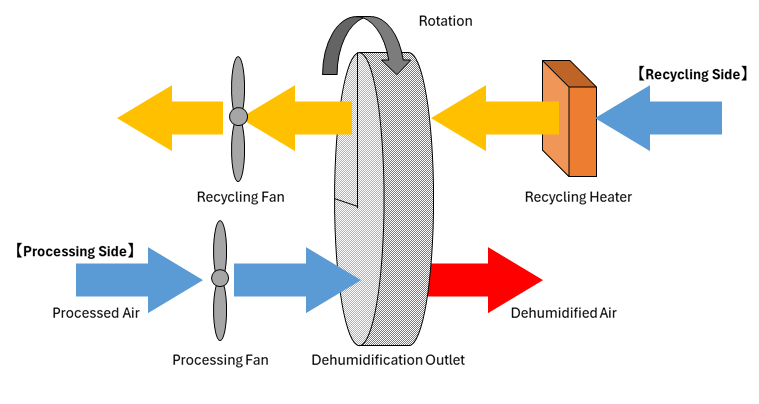
A model that can dehumidify with Apiste products
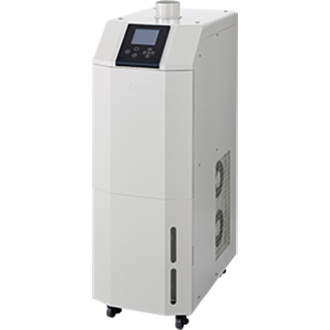
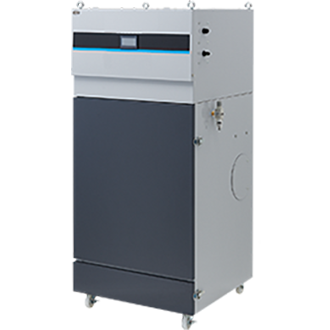
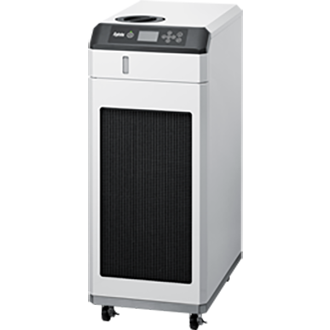
1. compressor-type cooling and dehumidification model
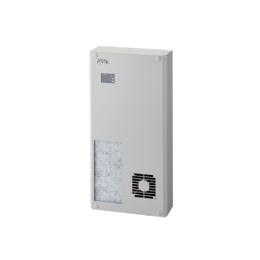
Product lineup here
- The ENC-GR-eco series allows you to choose between normal and dry modes.
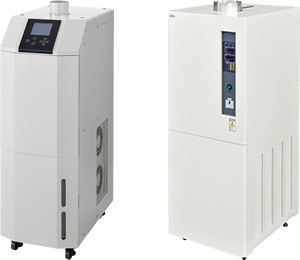
Product lineup
- The PAU-GR series offers a choice of normal, energy saving, and max dry modes.
- The PAU-DR series can automatically perform maximum dry operation.